The buyer is now software: a founder's paper
Why Handshakr exists: what happens to websites, SaaS and demand when the first reader of your company is a buying agent, and where the thesis could fail.
The short version
For twenty-five years I have sold technology to businesses. In all that time the first job was the same: get a person to look at you. Get the meeting, get the click, get the demo.
That job is ending. Not selling. The looking.
The first reader of your company is increasingly a piece of software working for the buyer. It does not admire your homepage. It does not sit through your demo. It asks whether you can do the thing, checks what it can, and moves on if it cannot tell.
My argument in this paper is simple. The website and the SaaS interface, as we have built them, are becoming the agent's interface, not the human's. When that happens, demand does not disappear. It gets decided somewhere you cannot see, by something you cannot charm. The companies that win will be the ones that can be read, checked and acted on by software. Handshakr exists to make that version of a company, and to certify it.
I have built this once already
Handshakr is not a new idea for me. I took it to market between 2019 and 2022 as "B2B commerce, always on": supplier and buyer profiles, deal rooms, matching.
It got traction, though not enough. Buyers and sellers both paid. Both sides showed up with real needs. The thesis held. The product did not. It was clunky, the transactions were heavy, and the sales cycles were long. The technology of the time could not do what I wanted it to do. There was nothing on the buyer's side that could read a supplier and act on it. A person still had to do all the reading, and people do not have the time.
So I am not writing this as someone who has just discovered agents. I am writing it as someone who built the supply side of this market before the demand side had a reader. The reader has now arrived.
What changed is who does the reading
Three things are true in late 2026 that were not true in 2022.
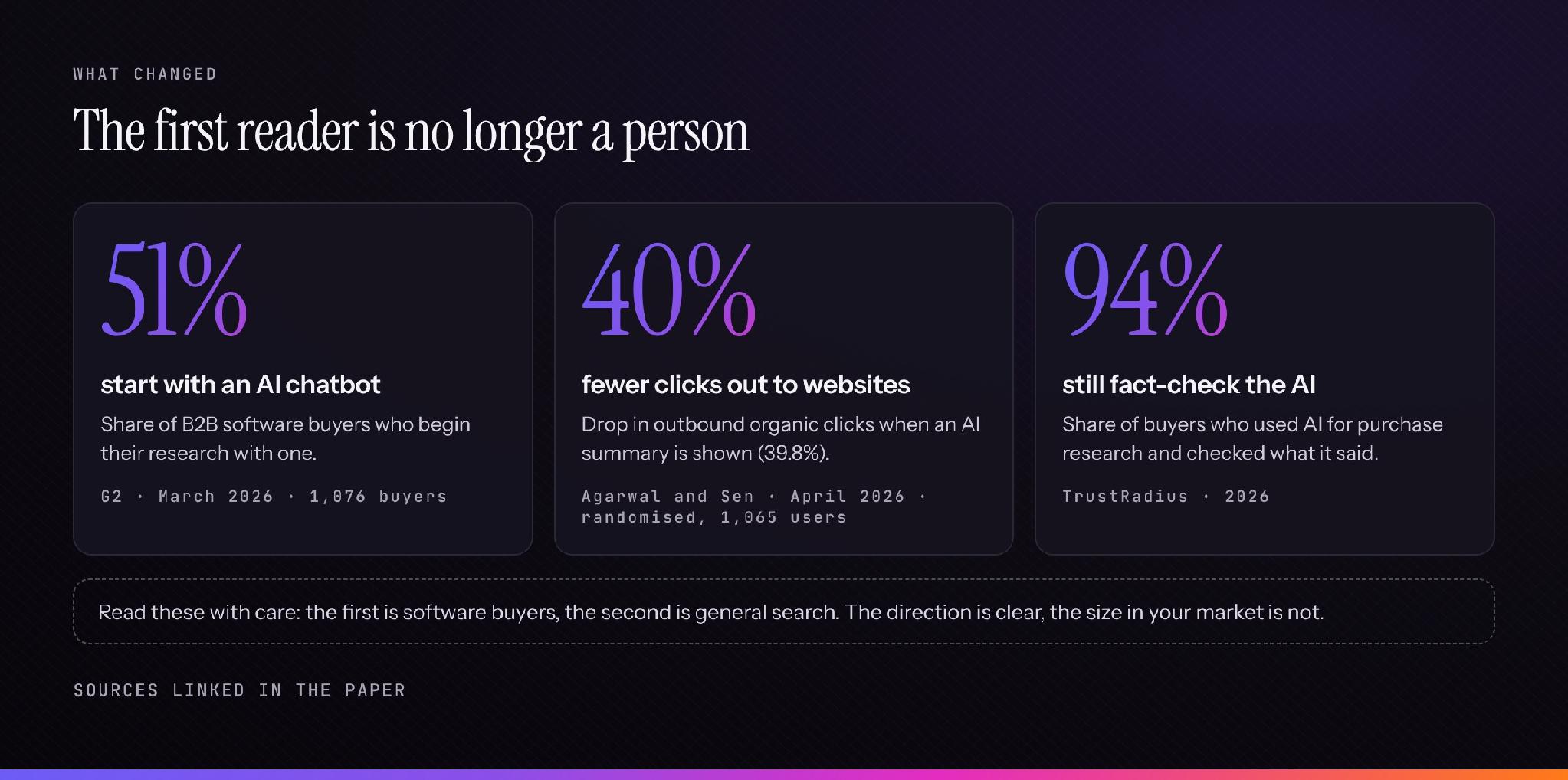
Buyers start with an assistant. In a March 2026 G2 survey of 1,076 B2B software buyers, 51% said they begin their research with an AI chatbot (Demand Gen Report). That is software buyers, who run ahead of everyone else. But every buying behaviour I have watched in my career started in software and ended up in everything.
The click is going. This is no longer anecdote. A randomised experiment by Agarwal and Sen, published in April 2026, hid Google's AI summaries from one group of users and compared them with another. Where a summary appeared, clicks out to websites were about 40% lower, and far more searches ended with no visit to anyone (MediaCat). The answer is given on the page. The visit never happens.
Agents can now do things, not just say things. There are open standards for how an agent connects to tools and data, and separate ones for checkout and payment. The plumbing for software to find, compare and transact is being laid by the largest companies in the industry, in public, right now.
Put those together. The buyer asks. The assistant reads. The shortlist is formed. Then, and only then, a human gets involved.
The website becomes a filing, not a destination
Here is the uncomfortable part for anyone who has spent money on a website.
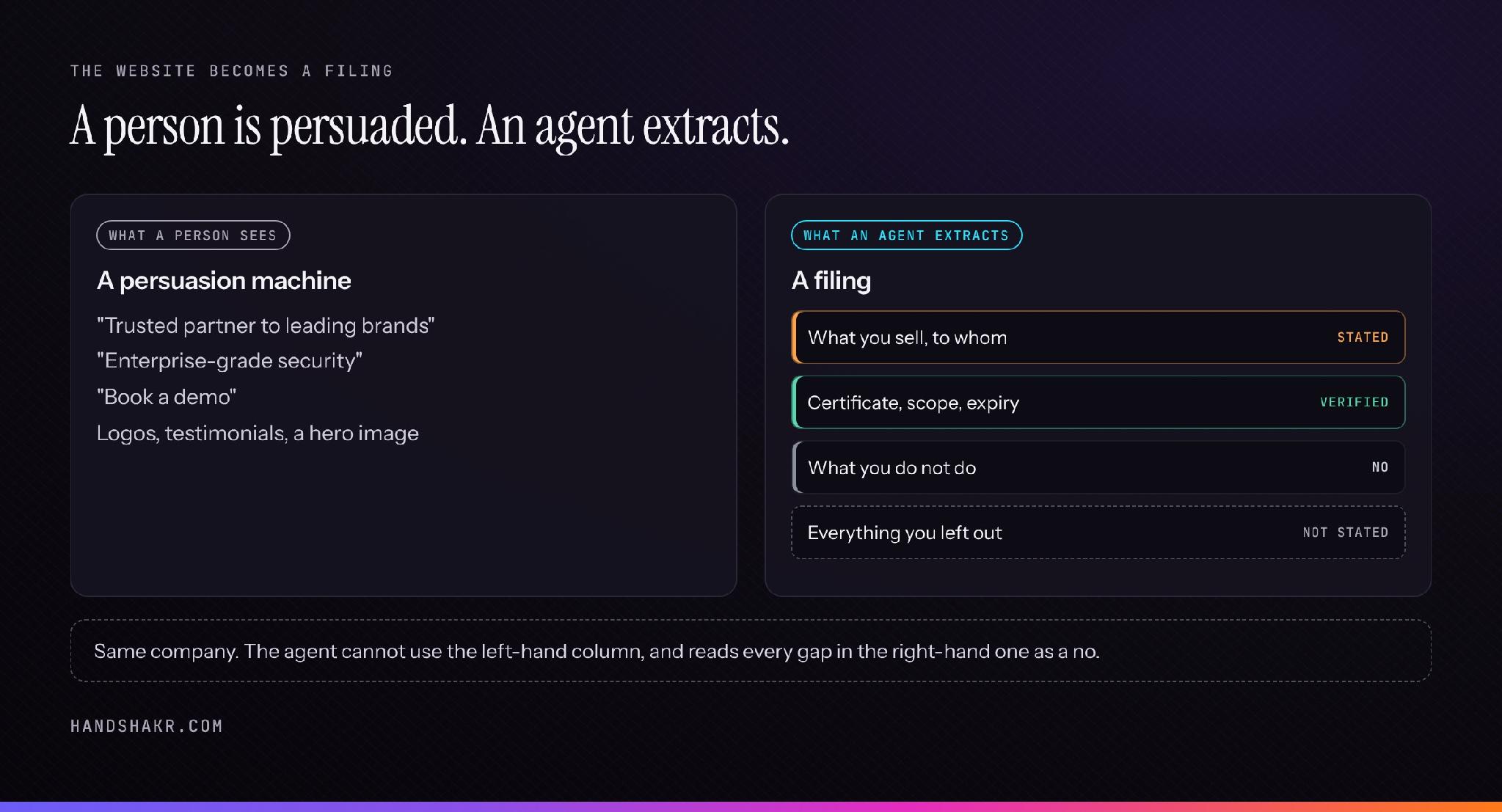
A website is a persuasion machine built for a human visitor. Hero line, social proof, a call to action. Every part of it assumes a person turns up, reads, and feels something.
An agent does none of that. It extracts facts. What do you sell. Where. To whom. For roughly how much. What can you prove. What do you not do. Everything else on the page is noise to it, and some of it is worse than noise, because "trusted partner to leading brands" is a claim it cannot check.
So the job of a website changes. It stops being the place where the buyer is persuaded and becomes the place where the facts are filed. Closer to a company's entry on a register than to a brochure. The human still visits, but later, and to confirm a decision that software has already narrowed.
I think most marketing teams have this backwards. They are asking how to get the AI to send them traffic. The better question is what the AI needs to say about you when no traffic is sent at all.
The same thing happens inside SaaS
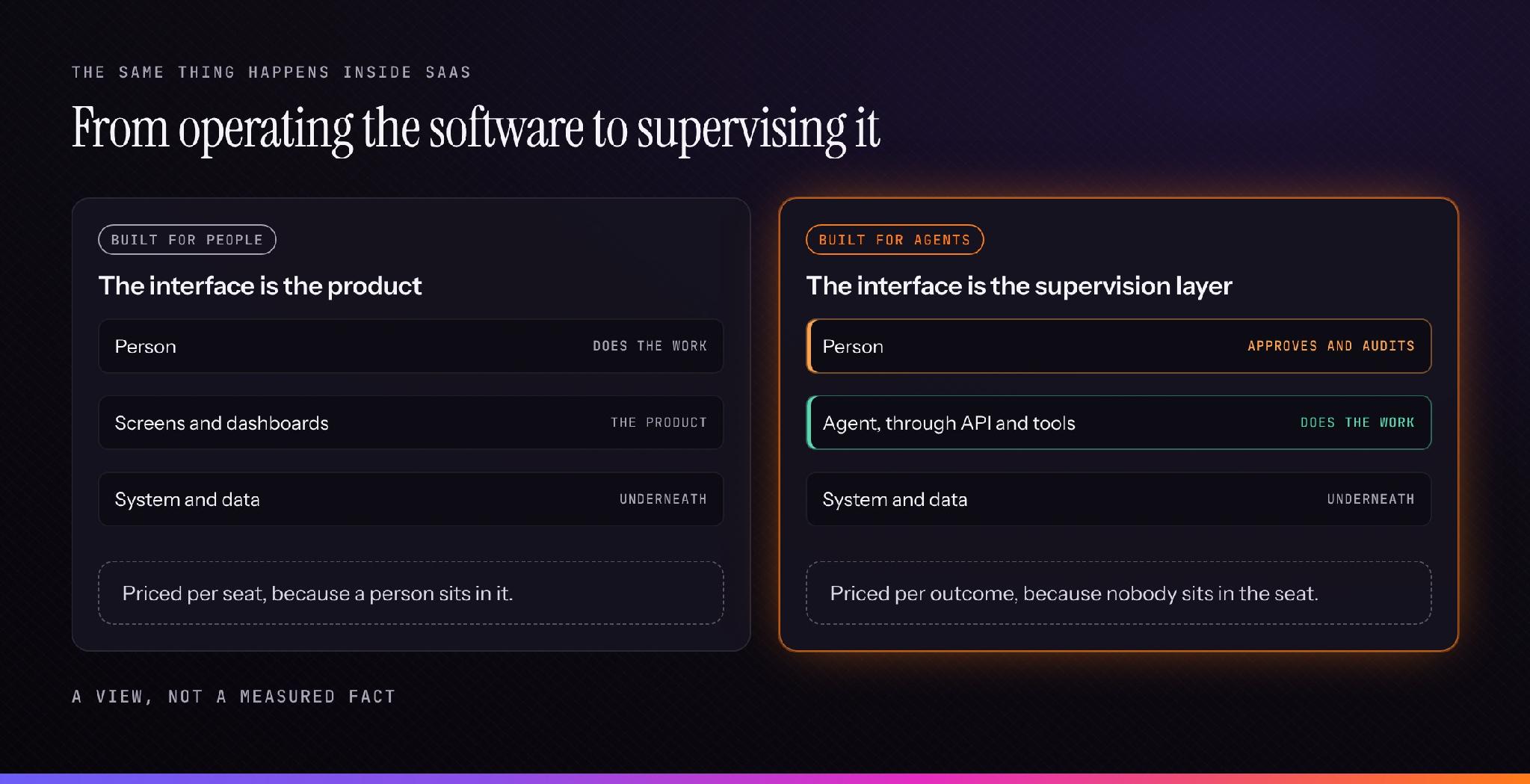
The interface of a SaaS product is also built for a human. Screens, dashboards, seats. We charge per seat because a person sits in it.
When an agent does the work, nobody sits in the seat. The product is still used, but through its API and its tools, not its screens. The vendors can see this coming, which is why pricing is moving. Intercom charges for its AI agent per resolved conversation, not per user, and Zendesk prices automated resolutions the same way (one summary of 2026 vendor pricing). When the unit of value stops being a login, the interface stops being the product.
My view, and it is a view: the user interface of most business software becomes the supervision layer. The place a person goes to approve, to check, to see what the agents did. The work itself happens underneath, agent to system. The products that survive are the ones an agent can operate safely and a human can audit quickly.
So what happens to demand?
This is the question I care about most, because I am a revenue person before I am anything else.
Demand does not vanish. Someone still needs payroll, cloud hosting, a fabricator, a law firm. What changes is where the demand is resolved and who can see it.
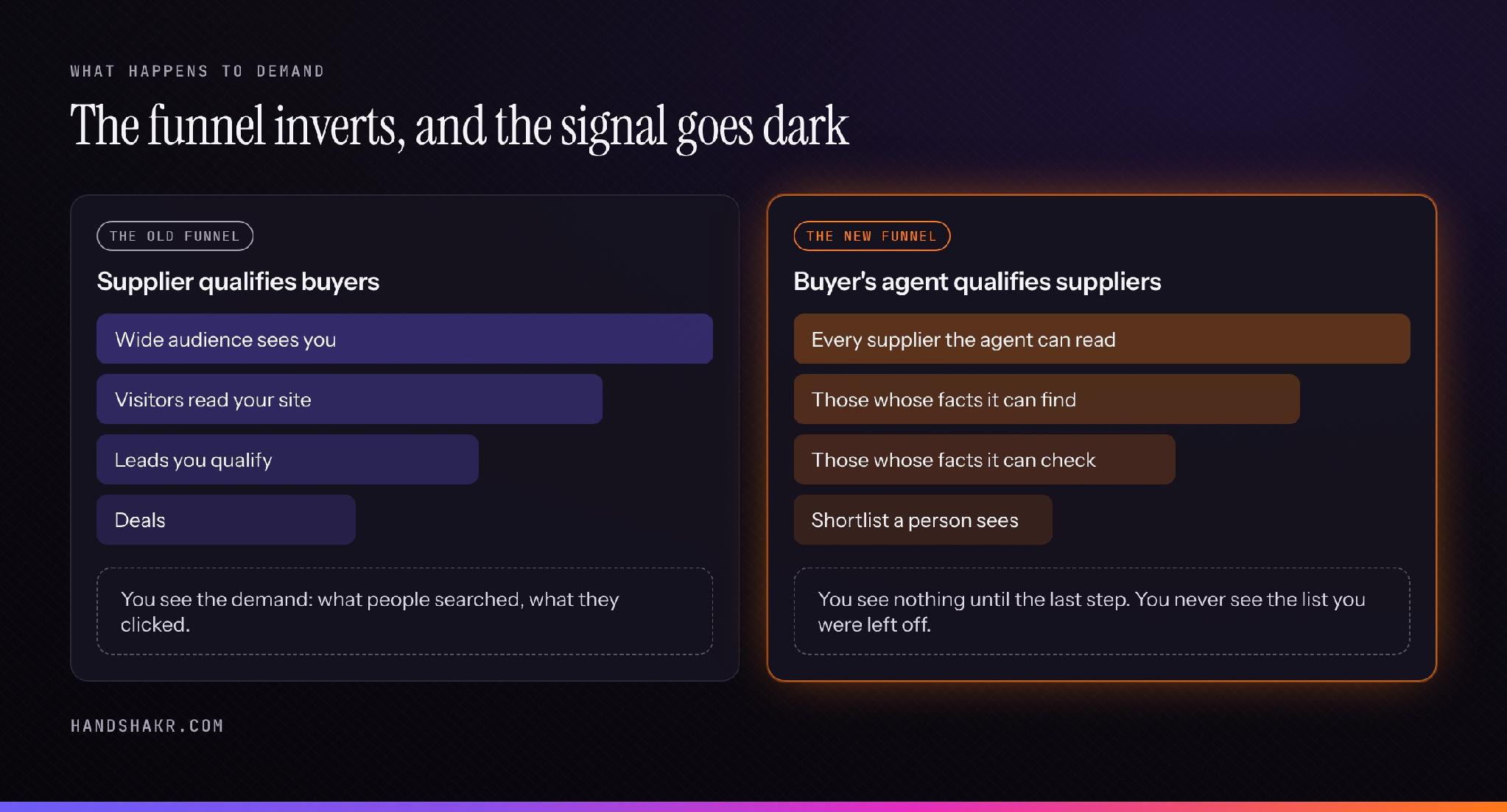
The funnel inverts. We used to pull a wide audience in and qualify them down. Now the buyer's agent qualifies suppliers down before any supplier knows a need exists. You are being evaluated in rooms you are not in.
You lose the signal. Search gave suppliers a view of demand: what people typed, what they clicked. If the question is asked in an assistant and answered without a visit, that signal goes dark. You do not see the shortlist you were left off. You certainly do not see why.
Persuasion loses to proof. Advertising and content were ways to buy attention. An agent's attention cannot be bought in the same way, or should not be. What it can use is evidence: a certificate with a date, a stated price, a clear no. Marketing budgets will move from saying to proving.
Silence becomes a no. This is the single most practical point in this paper. An agent cannot tell "we do not do this" from "we did not mention it". For a buyer, the safe reading of a blank is to move on. Most company websites are mostly blanks.
Fewer visits, each worth more. The person who does arrive has already been through the filter. They are not browsing. Sales teams will see fewer leads and better ones, and will need to stop measuring themselves on volume.
What stays human
I do not believe agents will be signing B2B contracts on their own any time soon, and I would not want them to. Anything binding needs a person with the authority to bind.
The evidence backs this up. In TrustRadius's 2026 research, 94% of buyers who used AI to research a purchase said they still fact-checked what it told them (TrustRadius). Buyers are using AI to go faster, not to stop thinking. Which is exactly why checkable facts matter: the human in the loop is checking.
Relationships still close deals. But relationships now start later, and you only get to start one if you survive the read.
The gap, and why Handshakr
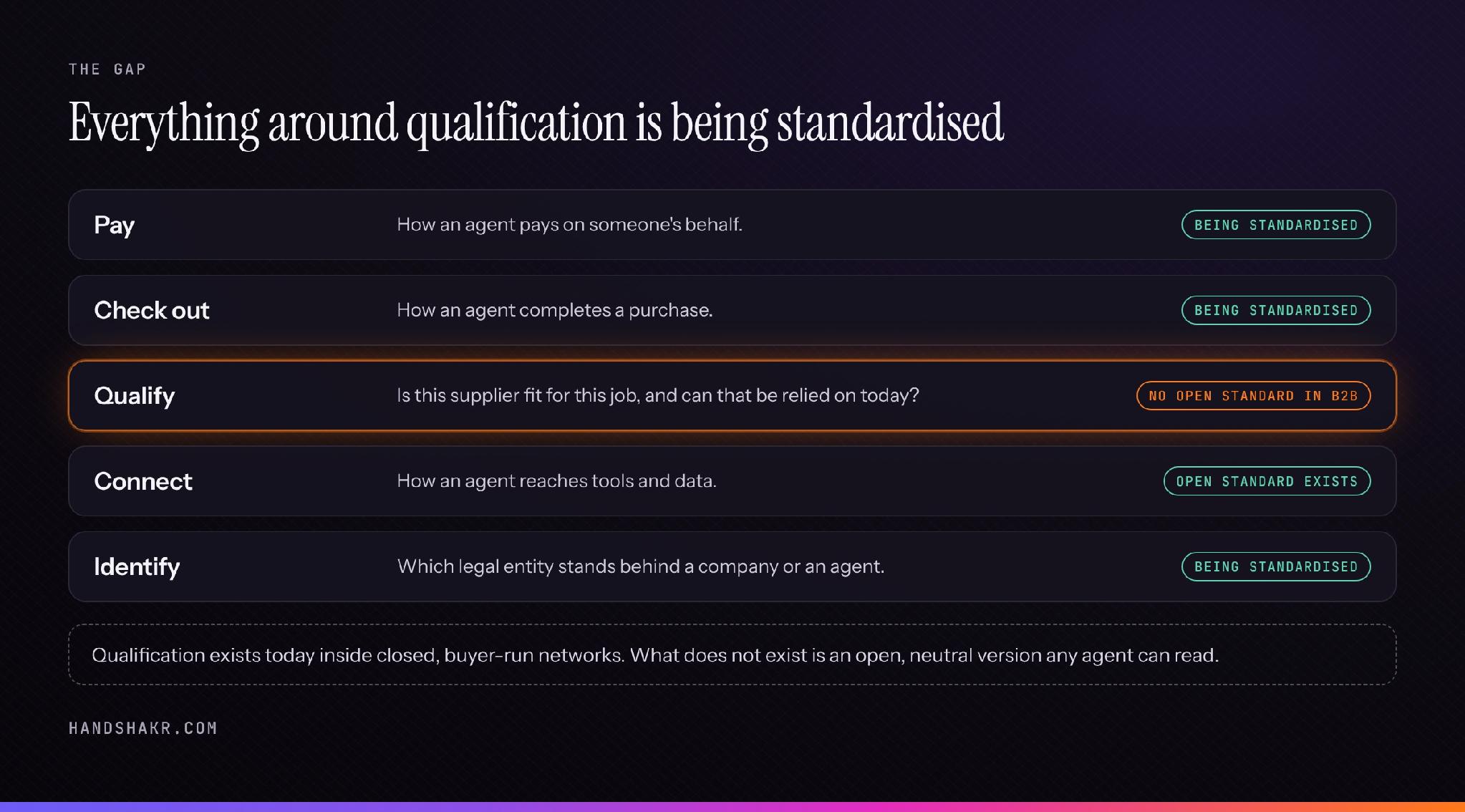
Look at what is being standardised. How an agent connects to a tool. How it checks out. How it pays. All of that is real and moving quickly, and most of it is aimed at consumer shopping.
What nobody has standardised is the B2B question that comes before any of it: is this supplier qualified for this job? Do they hold the certificate. Do they cover the region. Can they meet the service level. And can any of that be relied on today, not two years ago.
I want to be precise here, because it would be easy to overclaim. Supplier qualification is not new. Prequalification networks have done it for decades, mostly in regulated sectors, mostly paid for and mandated by large buyers, and mostly closed. The big procurement suites are now putting their own agents on top of their own supplier networks. Separately, there is serious work on proving which legal entity stands behind a company or an agent. What does not exist is an open, neutral qualification record that any agent can read, that a small supplier can afford, and that no single buyer or platform owns. That is the gap, and it is narrower and more specific than "nobody does this".
That is the layer Handshakr builds. A commercial passport: a company stated as structured facts that software can read. With rules I think any honest version of this layer needs:
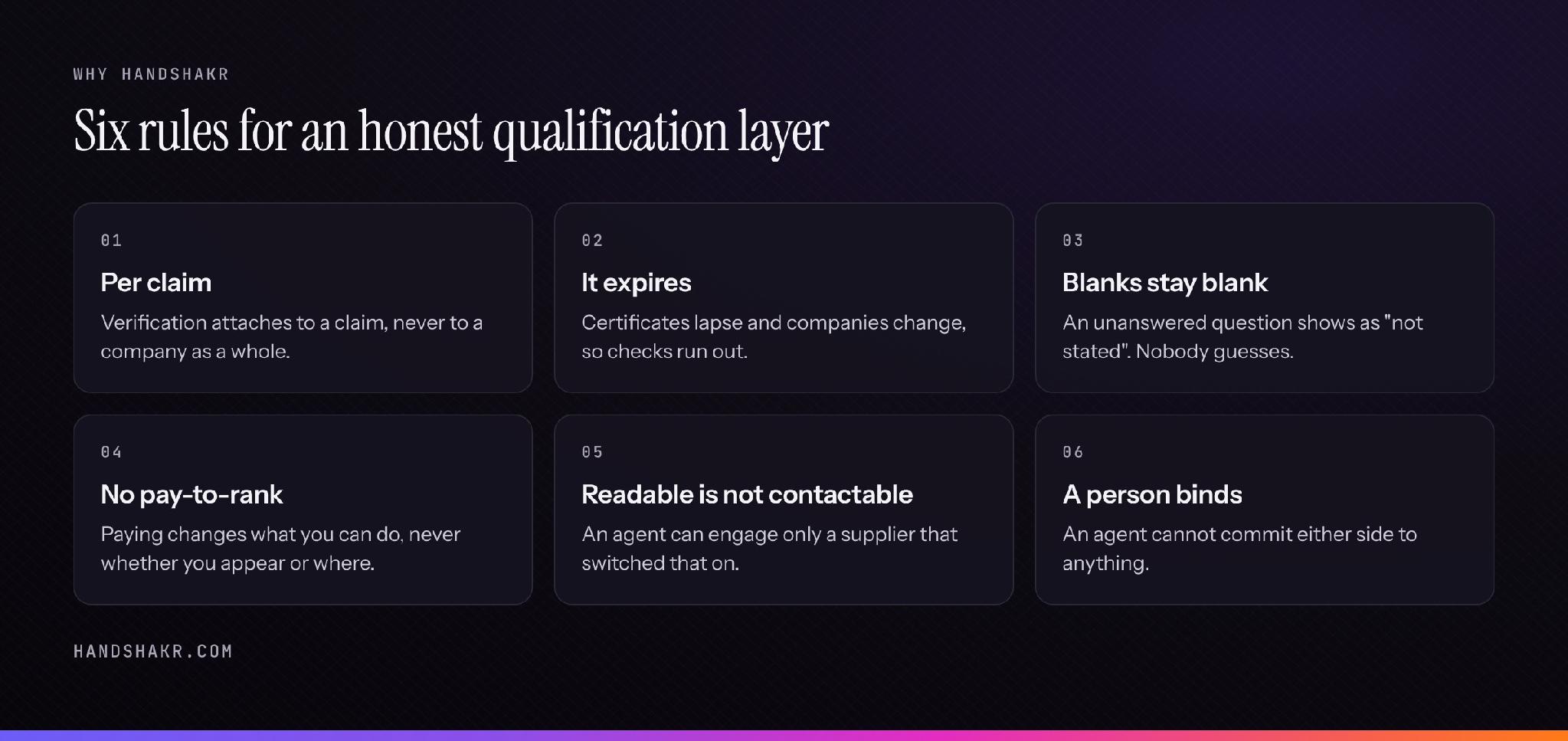
- Verification attaches to a claim, never to a company as a whole.
- Verification expires, because certificates lapse and companies change.
- A question nobody has answered stays visibly "not stated". We do not guess and no model fills it in.
- Paying changes what you can do, never whether you appear or where.
- Readable is not contactable. An agent can read a listing, but can only engage a supplier that has chosen to switch that on.
- An agent cannot commit either side. A person approves anything binding.
Handshakr does not implement the checkout and payment standards. It serves the open standard agents use to read tools and data. I see it as a passport now and, in time, a protocol for supplier qualification. That second step is a direction, not a product, and it deserves its own paper.
Where I could be wrong
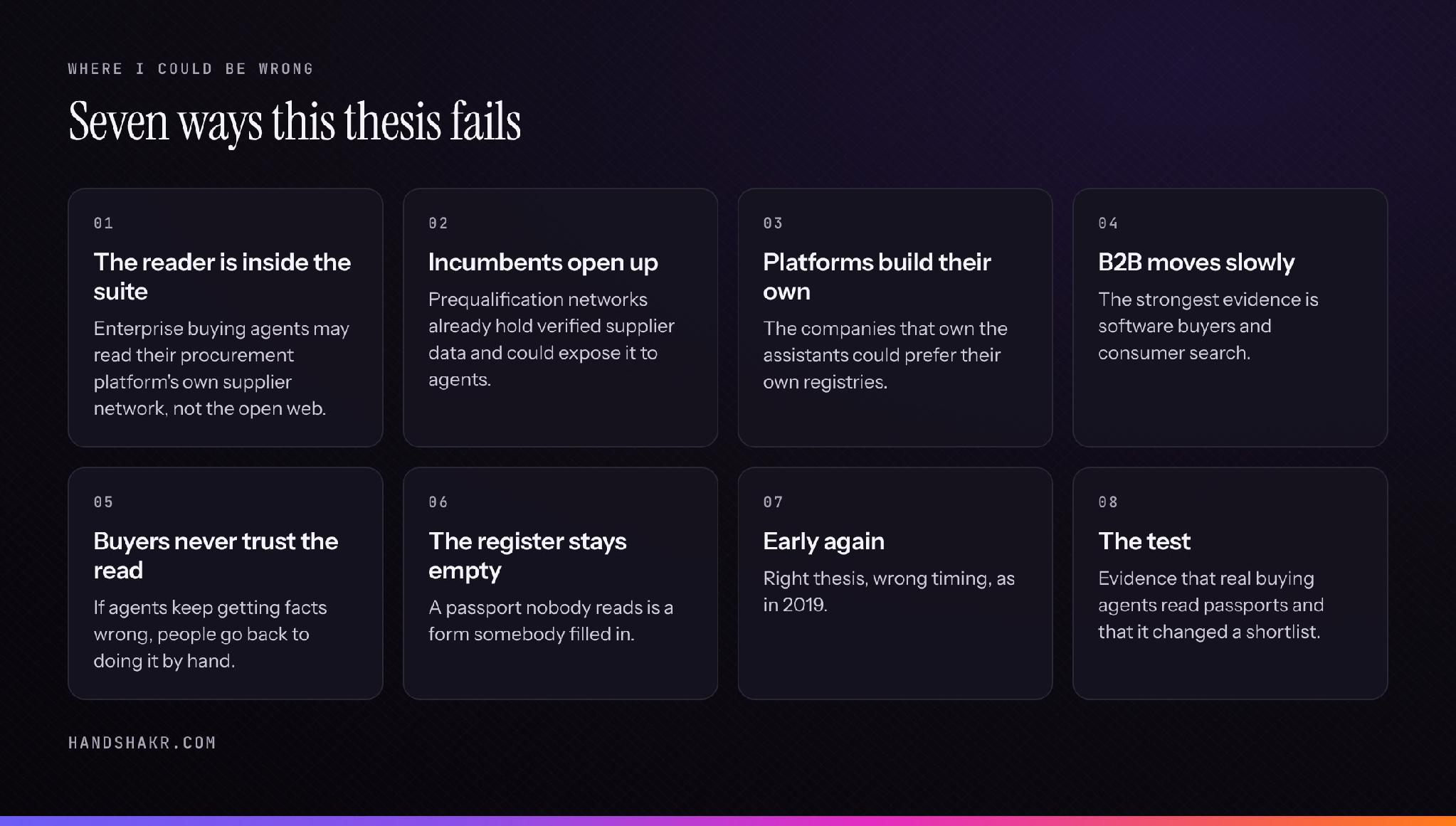
I would rather list these than have someone else do it for me.
The reader may be inside the procurement suite. In large companies the buying agent may live inside the procurement platform and read that platform's own supplier network, not the open web. If so, an open passport is only read if those platforms choose to read it. For smaller buyers using general assistants the open route is real. For enterprise it has to be earned through integration.
The incumbents may open up. The prequalification networks already hold verified data on hundreds of thousands of suppliers. If they expose it to agents, they start with the data I am still collecting. My edge would have to be neutrality, price and claim-level detail, not being first.
The platforms may do this themselves. The companies that own the assistants could build their own supplier registries and prefer them. My answer is neutrality: no AI platform gets privileged access, and a supplier should not have to file itself separately with each one. That is an argument, not a guarantee.
B2B may move slower than the surveys suggest. The strongest data is about software buyers and consumer search. A procurement team buying a regulated service may keep its existing process for years. The AI summary effect is also much weaker on buying-intent searches than on informational ones today.
Buyers may never trust the read. If agents keep getting facts wrong, people will go back to doing it by hand. I think verification is the fix for that, but it has to be proven in use.
A register is only useful when it is full. Every registry has a cold start. Mine does too. A passport nobody reads is a form somebody filled in.
I have been early before. In 2019 I was right about the thesis and wrong about the timing. I may be early again. The difference this time is that the reader exists.
The test for all of this is simple and I should hold myself to it: evidence that real buying agents read passports, and that being read changed who got shortlisted.
So what
If you run a supplier business: write down the ten facts buyers always ask you for, publish them plainly, date anything that expires, and say what you do not do. That costs an afternoon and it is worth doing whether or not you ever use Handshakr.
If you run a SaaS company: assume your next user is an agent. Ask whether it could operate your product without your screens, and whether a person could audit what it did. Then look hard at what you charge for.
If you run marketing or sales: stop counting visits. Start asking what an assistant says about you when asked, what it cannot confirm, and what it gets wrong.
For me: the bet is that qualification becomes infrastructure. That a company will need a version of itself that software can read, check and act on, in the same way it once needed a website. I built the wrong product for that idea once. I do not intend to do it twice.
Sources
- G2 survey of 1,076 B2B software buyers, March 2026, reported by Demand Gen Report
- Agarwal and Sen, randomised field experiment on AI Overviews, April 2026, reported by MediaCat
- TrustRadius, 2026 B2B Buying Disconnect research
- Vendor pricing for AI agents in 2026, summary by Deepak Gupta
- Model Context Protocol, the open standard for connecting agents to tools and data