How AI buying agents find B2B suppliers, step by step
How an AI buying agent goes from a buyer's question to a shortlist of suppliers, where suppliers drop out, and what to publish so yours stays in.
In short
An AI buying agent finds suppliers the way a careful researcher would, only faster: it turns the buyer's need into requirements, gathers candidates from sources it can read, checks each one against the requirements, and returns a shortlist with reasons. Suppliers drop out at the checking stage, usually because a fact the agent needed was missing or could not be confirmed. The fix is to state what you sell as specific, checkable facts in places an agent can read.
What is an AI buying agent?
It is software that researches a purchase on a buyer's behalf. Sometimes it is a general assistant answering "who can do this for us?". Sometimes it is a purpose-built procurement tool. Either way the buyer gets an answer that names suppliers, compares them and rules some out, often without the buyer opening a supplier's website.
How common is this already?
Common enough to plan for. In a March 2026 G2 survey of 1,076 B2B software buyers, 51% said they now start their research with an AI chatbot (reported by Demand Gen Report). Research from Responsive, published in October 2025, found that a quarter of B2B buyers used generative AI more often than conventional search when researching vendors (Business Wire). Both surveys lean towards software and larger buyers, so treat them as direction, not as a measure of your own market.
What steps does an agent go through?
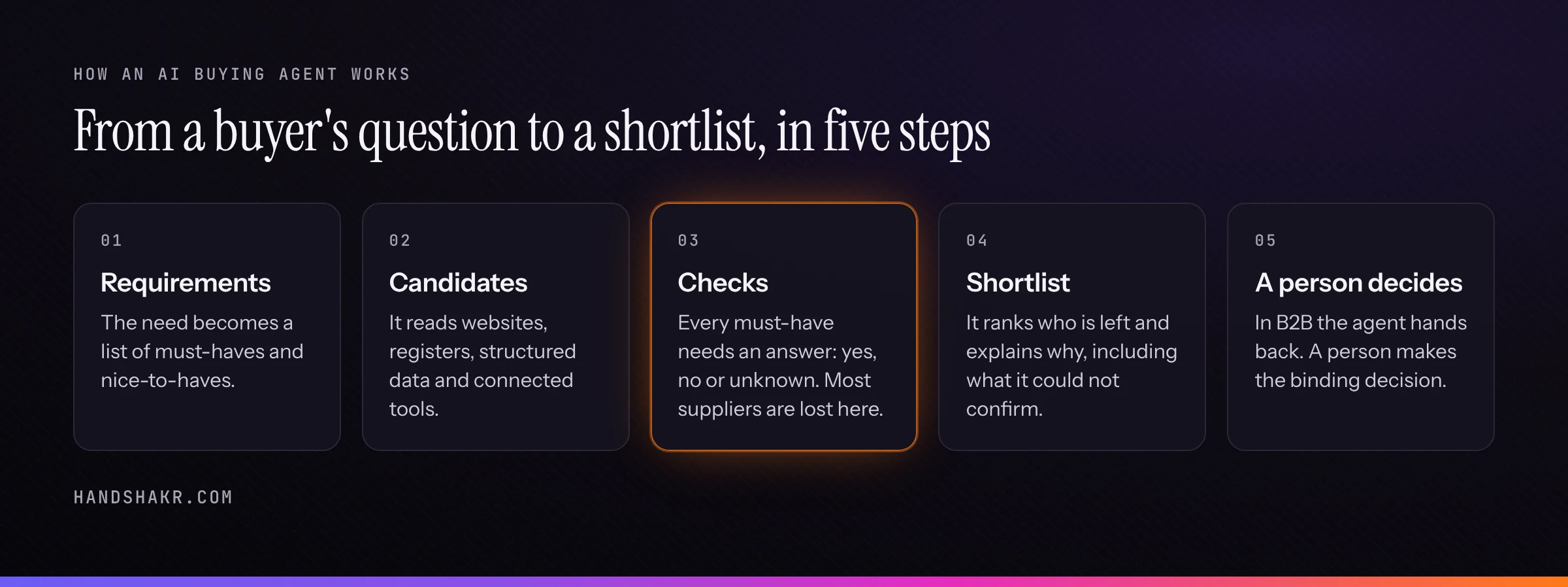
- It turns the need into requirements. A request like "a UK payroll provider for 200 staff, ISO 27001, live in 90 days" becomes a list of must-haves and nice-to-haves.
- It gathers candidates. It reads what it can reach: websites, directories and registers, structured data on pages, and tools or APIs it has been connected to.
- It checks each candidate against each requirement. This is where most suppliers are lost. For every must-have the agent needs an answer: yes, no, or unknown.
- It ranks and explains. A good agent says why each supplier is on the list and what it could not confirm.
- It hands back to a person. In B2B, a person still decides. The agent's job is to make that decision quicker and easier to defend.
Where do suppliers drop out?
Three places, and none of them is about price.
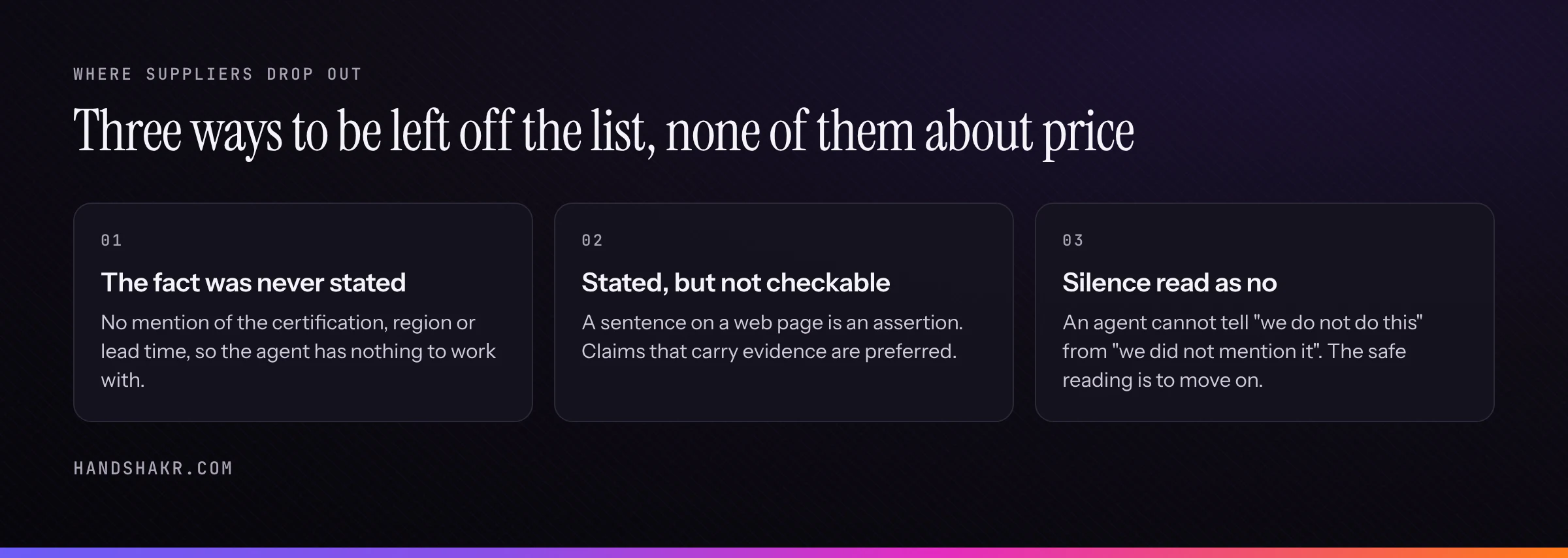
- The fact was never stated. If your site does not say whether you hold a certification, cover a region or meet a lead time, the agent has nothing to work with.
- The fact was stated but could not be checked. A sentence on a web page is an assertion about yourself. An agent comparing ten suppliers will prefer the ones whose claims carry evidence.
- Silence read as no. An agent cannot tell "we do not do this" from "we did not mention it". For a buyer, the safe reading of a blank is to move on.
What information helps an AI recommend a supplier?
Specific facts beat persuasive copy. The questions an agent needs answered are usually these:
| The agent asks | A useful answer looks like |
|---|---|
| What exactly do you sell? | Named products or services, each with who it suits |
| Where do you work? | Countries or regions, stated plainly |
| What does it cost, roughly? | A price, a range or a pricing model |
| Which certifications do you hold? | The certificate, its scope and its expiry date |
| How fast can you deliver? | A lead time or onboarding period |
| What do you not do? | A clear "no" where the answer is no |
The last row matters more than it looks. A stated "no" keeps you out of the wrong shortlists and makes your "yes" answers more believable.
What can a supplier do this week?
This part is general guidance, not specific to any platform.
- Write down the ten facts buyers always ask you for, and publish them in plain sentences, not buried in a PDF.
- Add dates to anything that expires, such as certificates and insurance.
- Say what you do not do.
- Make sure your pages can be read by AI crawlers: check your robots.txt and add Organization markup to your site.
What Handshakr does about this
This part describes the product. A Handshakr passport is your company stated as structured facts rather than prose: what you sell, who it suits, where you work and roughly what it costs. Each claim carries its own evidence and verification state, so a reader can tell an assertion from a check. Anything you have not told us stays visibly "not stated". We do not guess it, and no model fills it in.
Claiming your passport is free, and so is having it served in full to any buying agent that asks. You can also run the free agent-readiness check on your own site. It looks at HTTPS, Organization markup, your robots.txt rules for AI crawlers, llms.txt and your passport, and it gives findings, not a score.
Frequently asked questions
Do AI buying agents visit supplier websites?
They can read them, but the buyer often never does. The agent summarises what it found, so the buyer's first impression of you is the agent's answer.
Can an AI agent place an order with a supplier?
On Handshakr, no. An agent can research, ask and draft or request an offer, but anything binding needs a person with the authority to approve it.
Does a better website fix this?
Only partly. An agent can already read a normal website. What it cannot do is confirm a claim or tell a "no" from a blank, and more marketing copy does not change either.
Where should I start?
Search the Handshakr register for your company. If it is there, claim its passport and correct it. If it is not, create one. Both are free.
Sources and further reading
- G2 survey of 1,076 B2B software buyers, March 2026, as reported by Demand Gen Report
- Responsive, B2B buyer research, October 2025, press release on Business Wire
- Model Context Protocol, the open standard AI agents use to connect to tools and data
- schema.org Organization, the markup that describes a company to search engines and AI crawlers