How AI agents check supplier claims: stated or verified
An AI agent treats a supplier claim as stated, verified or missing. What each state means, why a blank reads as no, and how to prove what you say.
In short
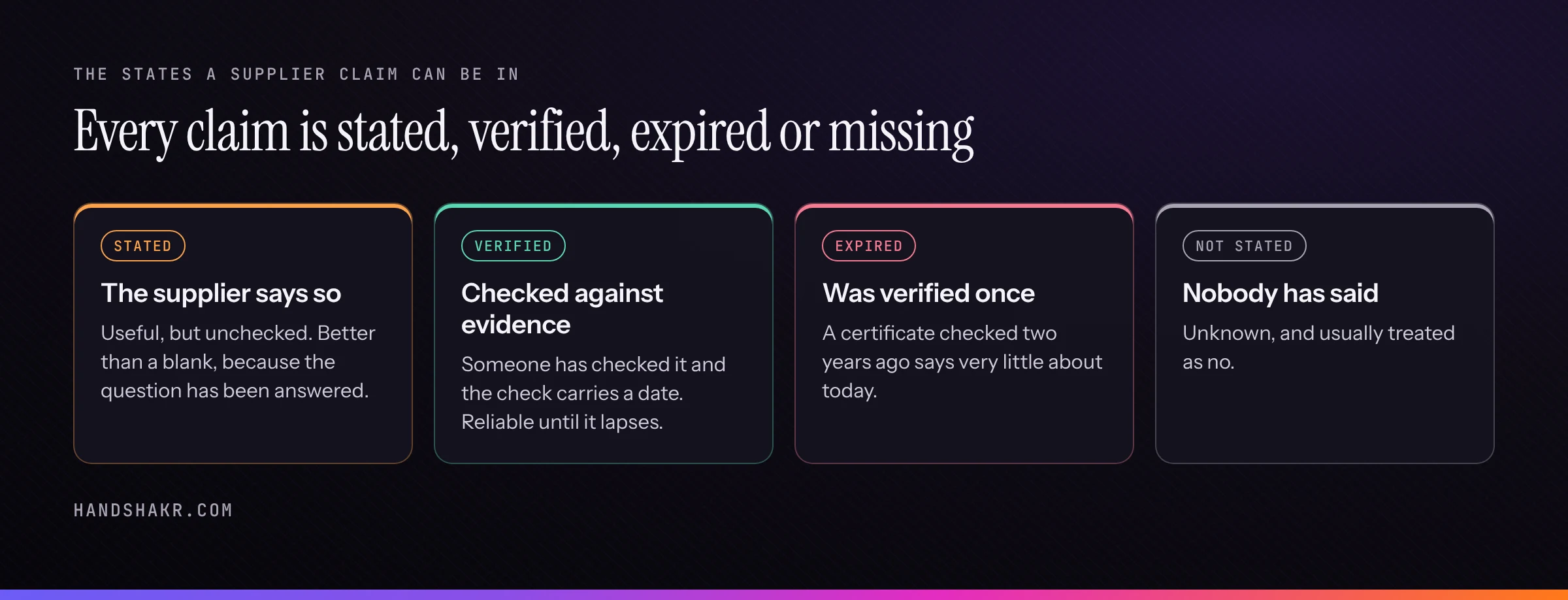
An AI agent cannot inspect your factory or ring your auditor. It can only weigh what it reads. In practice every claim about a supplier ends up in one of three states: stated by the supplier, verified against evidence, or missing. Missing is the dangerous one, because an agent cannot tell "they do not do this" from "they never said", and buyers treat both as no.
What counts as a supplier claim?
Any factual statement a buyer might rely on: a certification, a hosting region, a service level, a delivery area, a minimum order, a lead time. "We are a trusted partner" is not a claim. "We hold ISO 27001, certificate valid to March 2027" is.
What are the three states a claim can be in?
| State | What it means | How a buyer should read it |
|---|---|---|
| Stated | The supplier says so | Useful, but unchecked |
| Verified | Someone has checked it against evidence, and the check has a date | Can be relied on until it lapses |
| Not stated | Nobody has said either way | Unknown, and usually treated as no |
A fourth situation deserves its own line: a claim that was verified once and has since expired. A certificate checked two years ago says very little about today.
Can an AI tell missing information from a lack of capability?
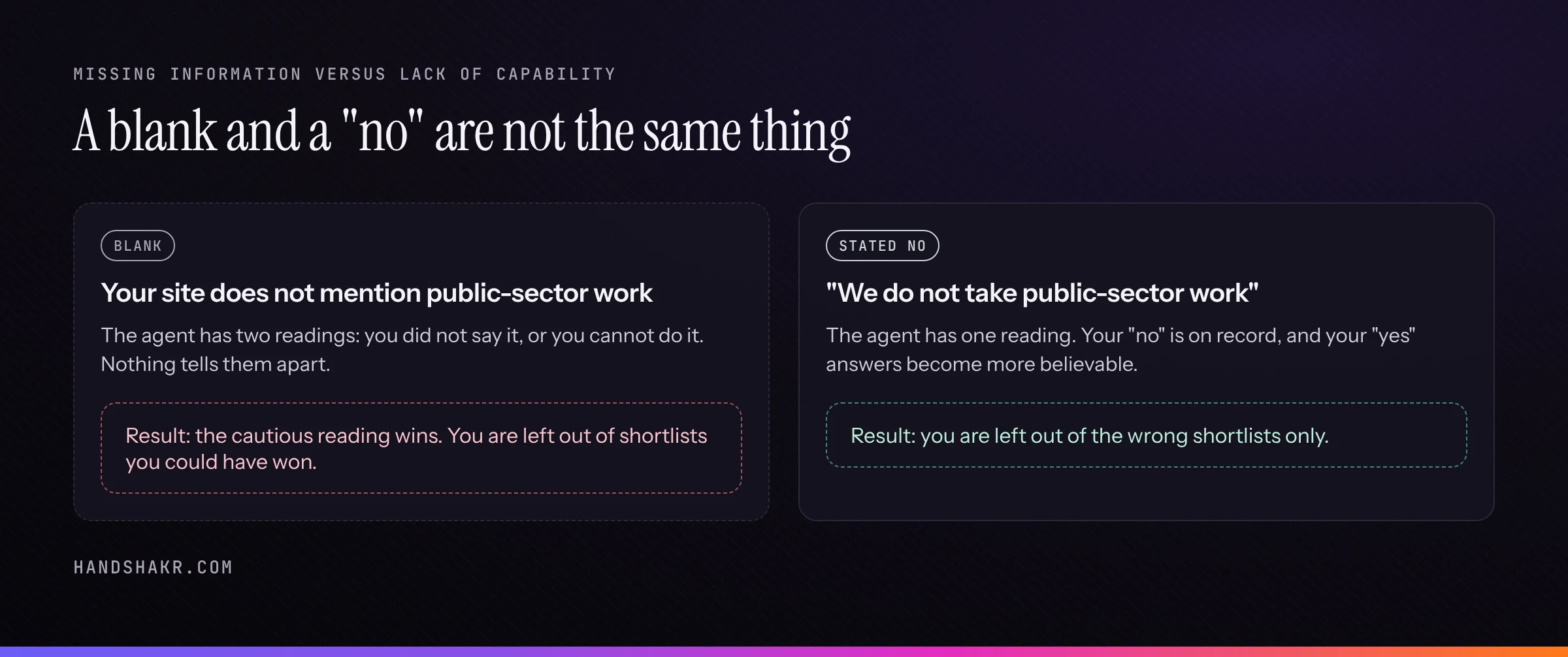
No, not from a web page alone. If your site does not mention public-sector work, an agent has two possible readings: you did not say it, or you cannot do it. With nothing to tell them apart, the cautious reading wins and you are left out.
This is why a clear "no" is worth publishing. It separates the things you do not do from the things you simply have not mentioned, and it stops a blank doing your talking for you.
How do you prove a capability online?
This part is general guidance.
- Name the claim precisely. "ISO 27001 for our UK hosting operation" is checkable. "Enterprise-grade security" is not.
- Point to evidence. A certificate, a public register entry, a policy document, a named standard.
- Give the date and the expiry. Evidence without a date invites doubt.
- Say who checked it. A self-declaration and an independent check are different things, and a reader should be able to see which they are looking at.
- Keep it current. Remove or update a claim when the evidence lapses.
What is the best way to verify a supplier's certifications?
If you are the buyer, go to the source where you can: the certification body or the public register that issued it. For accredited management system certificates such as ISO 9001 or ISO 27001, two free public databases exist for exactly this: UKAS CertCheck for UKAS-accredited certification, and IAF CertSearch worldwide. ISO itself points buyers to IAF CertSearch, and notes that it covers accredited certificates only. Check the scope, not just the logo, because a certificate can cover one site or one service and not the thing you are buying. Check the expiry date. And ask the supplier for anything you cannot find, in writing, so the answer is on record.
If you use an agent to do the first pass, ask it to show you which claims it confirmed, which it only read on the supplier's site, and which it could not find. A shortlist that hides that distinction is not much use. Buyers already work this way: in TrustRadius's 2026 buying research, 94% of buyers who used AI to research a purchase said they still fact-checked what it told them (TrustRadius).
What Handshakr does about this
This part describes the product. On Handshakr, verification attaches to individual claims, such as a certification, a hosting region or an SLA, and never to a company as a single whole. A company is not "verified". A claim is.
Verification also expires. One granted in March does not read as current in December, because certificates lapse and companies change hands. And a question you have not answered stays visibly "not stated", so a reader can see the difference between a blank and a no.
The supplier evidence checklist lists the questions a buying agent asks a B2B supplier and the evidence that answers each one.
Frequently asked questions
Does a verified badge mean the whole company has been vetted?
Not on Handshakr. Verification is per claim, so you can see exactly which statements have been checked and which are only stated.
Who does the checking?
On Handshakr, a person reviews the evidence you submit for a claim and decides. Two facts are checked automatically and say so: your company registration, against Companies House, and your control of your own website's domain.
Can paying make a claim look more trustworthy?
No. Paying changes what you can do, never whether you appear or where. A plan is not an input to matching.
What if a claim is true but I have no document for it?
It stays as stated. That is still better than a blank, because the reader knows you have answered the question.
Sources and further reading
- UKAS CertCheck, free database of UKAS-accredited management system certification
- IAF CertSearch, global database of accredited management system certificates
- ISO, How to verify an accredited certification
- TrustRadius, 2026 B2B Buying Disconnect research