No pay-to-rank: how to compare supplier discovery platforms
Seven questions to ask any supplier discovery or verification platform, from pay-to-rank to who can contact you, with Handshakr's own answers.
In short
Supplier discovery platforms differ less in features than in rules: who can appear, what decides the order, who checks the facts, and who may contact you. Ask every platform the same seven questions and the differences become obvious. The most important is whether payment affects ranking, because if it does, a buyer's shortlist is partly an advert.
Why does pay-to-rank matter?
A buyer, or a buyer's AI agent, uses a platform to find the best fit. If position can be bought, the result answers a different question: who paid most. That is bad for buyers, and it is bad for good suppliers who would have won on the facts.
It matters more with AI agents in the loop. An agent that reads a ranked list has no way to know the ranking was sold unless the platform says so. A platform with a published no pay-to-rank rule gives the agent something it can rely on.
Buyers are already wary. In TrustRadius's 2026 research, 94% of buyers who used AI to research a purchase still fact-checked what it told them (TrustRadius). A platform whose order can be bought gives them one more thing to distrust.
What are the seven questions to ask?
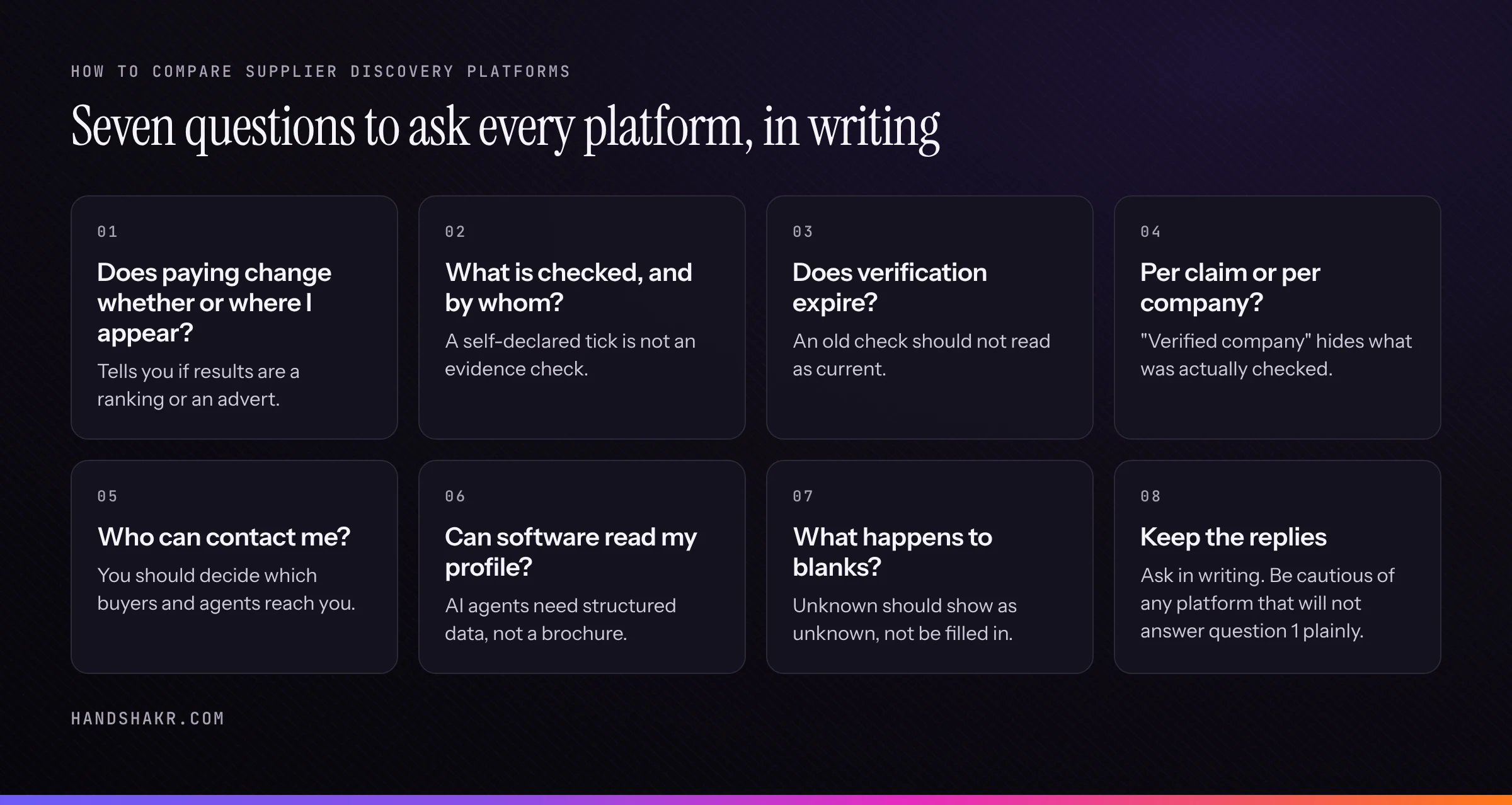
| Question | Why it matters |
|---|---|
| 1. Does paying change whether or where I appear? | Tells you whether results are a ranking or an advert |
| 2. What is checked, and by whom? | A self-declared tick and an evidence check are not the same thing |
| 3. Does verification expire? | An old check should not read as current |
| 4. Is verification per claim or per company? | "Verified company" hides which statements were actually checked |
| 5. Who can contact me, and can I switch that off? | You should decide which buyers and agents reach you |
| 6. Can software read my profile, not just people? | AI agents need structured data, not a brochure page |
| 7. What happens to questions I have not answered? | A blank should show as unknown, not be filled in or hidden |
How should I use the answers?
This part is general guidance. Ask each platform in writing and keep the replies. Be cautious about any platform that will not answer question 1 plainly. For questions 2 to 4, ask to see a real verified profile and look for dates and scope. For question 5, find the setting before you sign up, not after.
We have deliberately not rated named competitors here. Their terms change, and you should read each platform's current rules for yourself. Handshakr's compare page sets it beside other kinds of tool, such as websites, review sites, pre-qualification databases and trust centres, by what each kind does.
How does Handshakr answer the seven questions?
This part describes the product.
- Pay-to-rank. No. Paying changes what you can do, never whether you appear or where. Commercial tier is not an input to matching and it is not a filter on discovery.
- What is checked. Individual claims, against evidence you submit. A person reviews it and decides within 2 working days.
- Expiry. Yes. Verification expires, so a check granted in March does not read as current in December.
- Per claim or per company. Per claim, such as a certification, a hosting region or an SLA. Never the company as a single whole.
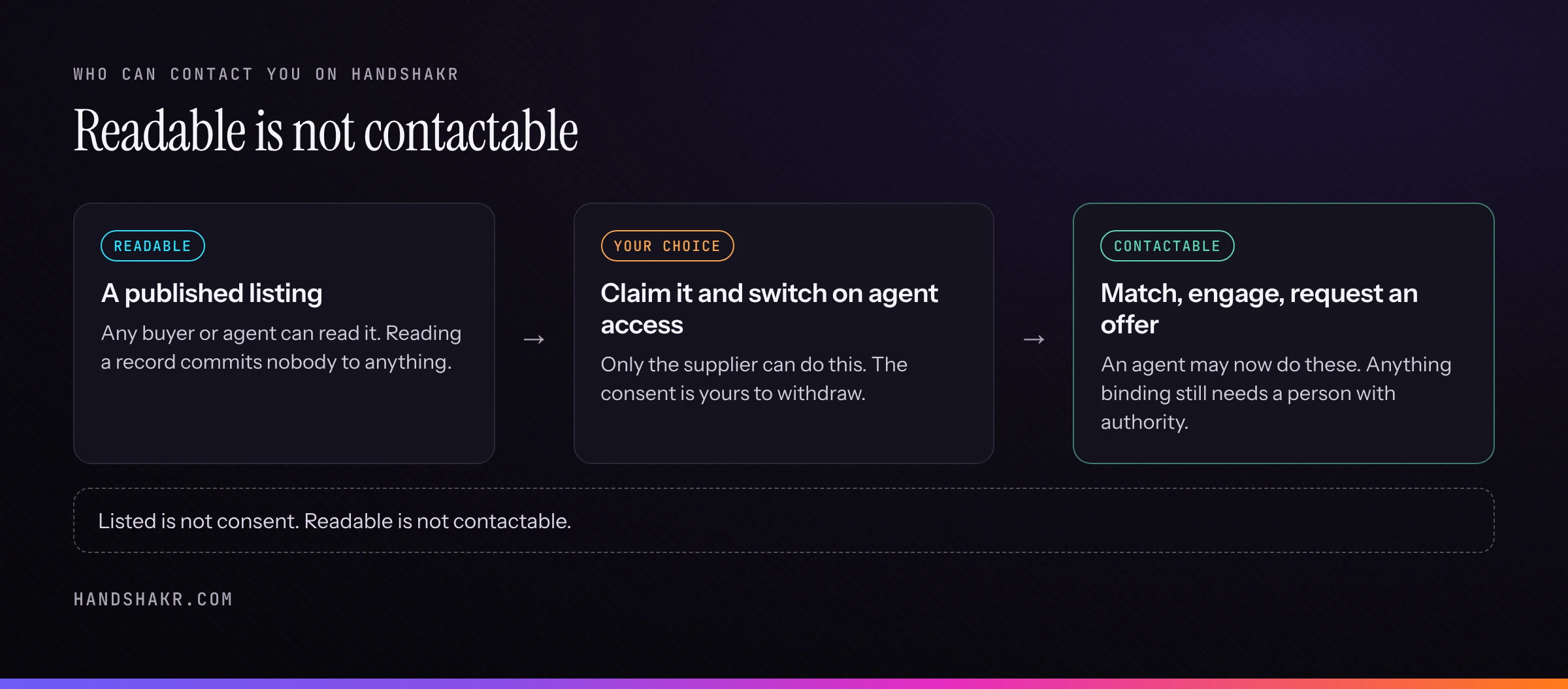
- Who can contact you. Readable is not contactable. A published listing can be read, but an agent may only match, engage or request an offer from a supplier that has claimed its listing and switched on agent access. That consent is yours to withdraw.
- Machine-readable. Yes. A passport is a versioned JSON document served to software, and there is a read-only MCP server for AI agents.
- Unanswered questions. They stay visibly "not stated". We do not guess, and no model fills them in.
Is Handshakr a marketplace?
No. It is a register of commercial passports that buyers and their agents can read and check. There is no position to buy.
What does Handshakr not do?
Honesty about limits is part of the comparison. Handshakr does not implement the checkout and payment standards ACP, UCP or AP2; it serves MCP. It does not let an agent commit either side to a deal: every binding decision needs a person with the authority to make it. And it does not vouch for a company as a whole, only for the specific claims that have been checked.
Frequently asked questions
Does Handshakr rank suppliers based on payment?
No. Paying changes what you can do, never whether you appear or where.
Can I stop AI agents contacting my company?
Yes. Agents can only match, engage or request an offer if you have claimed your listing and switched on agent access, and you can withdraw that consent.
Is a free listing a lesser listing?
No. A Claimed passport is served in full to every buying agent that asks. Paid plans add verification and tools, not visibility.
Can I use a profile without changing our procurement or sales systems?
Yes. A passport sits alongside what you already use.
See how it works for the four layers, or pricing for the plans.
Sources and further reading
- TrustRadius, 2026 B2B Buying Disconnect research
- Model Context Protocol, the open standard Handshakr serves
- UKAS CertCheck and IAF CertSearch, for checking a platform's or supplier's certification claims yourself