Being recommended by AI is not the same as being bought from
A supplier can appear in every AI answer about its category and still never make a shortlist. Being mentioned and being eligible are different things.
A supplier can appear in every AI answer about its category and still never make a shortlist. Being mentioned and being eligible are different things, and most advice for suppliers stops at the first.
Ask an AI assistant who supplies managed IT in South Wales and it will name some firms. That is visibility. Before software buys for a business, it checks: is the certification current, does the supplier cover this region, can someone there commit to these terms? If those answers can't be read, the supplier drops out, however often it was mentioned.
This matters because the buyer is changing. Gartner expects AI agents to intermediate 90% of B2B purchases by 2028, worth more than $15 trillion (SiliconANGLE).
Three different jobs
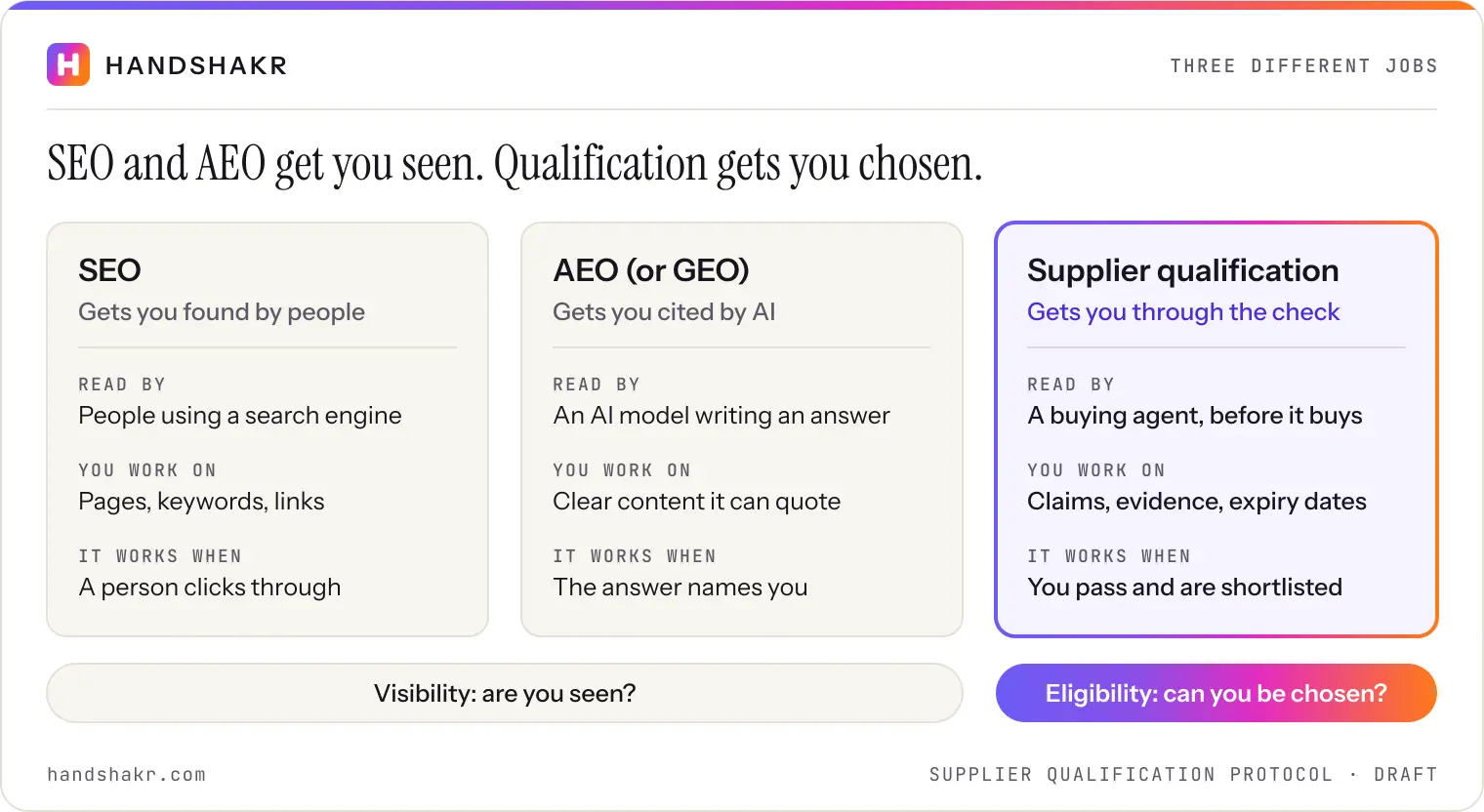
SEO and AEO (some call it GEO) are both about visibility, and they feed each other. Supplier qualification is about eligibility: whether an agent that has found you is able to choose you.
Where visibility stops
SEO and AEO both work on whether you are seen. Neither can answer the questions an agent asks once it is deciding who goes on the shortlist.
| What the agent asks | Can a web page or an AI answer settle it? | What settles it |
|---|---|---|
| Is the certification current today? | No. A page says "certified", not until when | An expiry date, and who checked it |
| Do you serve this region? | Sometimes, buried in prose | A stated service area a machine can compare |
| Where is customer data held? | Often missing | One statement, with evidence behind it |
| Can you start within 30 days? | Rarely stated | A stated lead time, or an honest "not stated" |
| Who can commit you to these terms? | No | A named person with authority to approve |
A well-optimised page gets the supplier into the conversation. It does not make any of these answers checkable, and an agent that cannot check an answer treats it as unknown.
The order it happens in
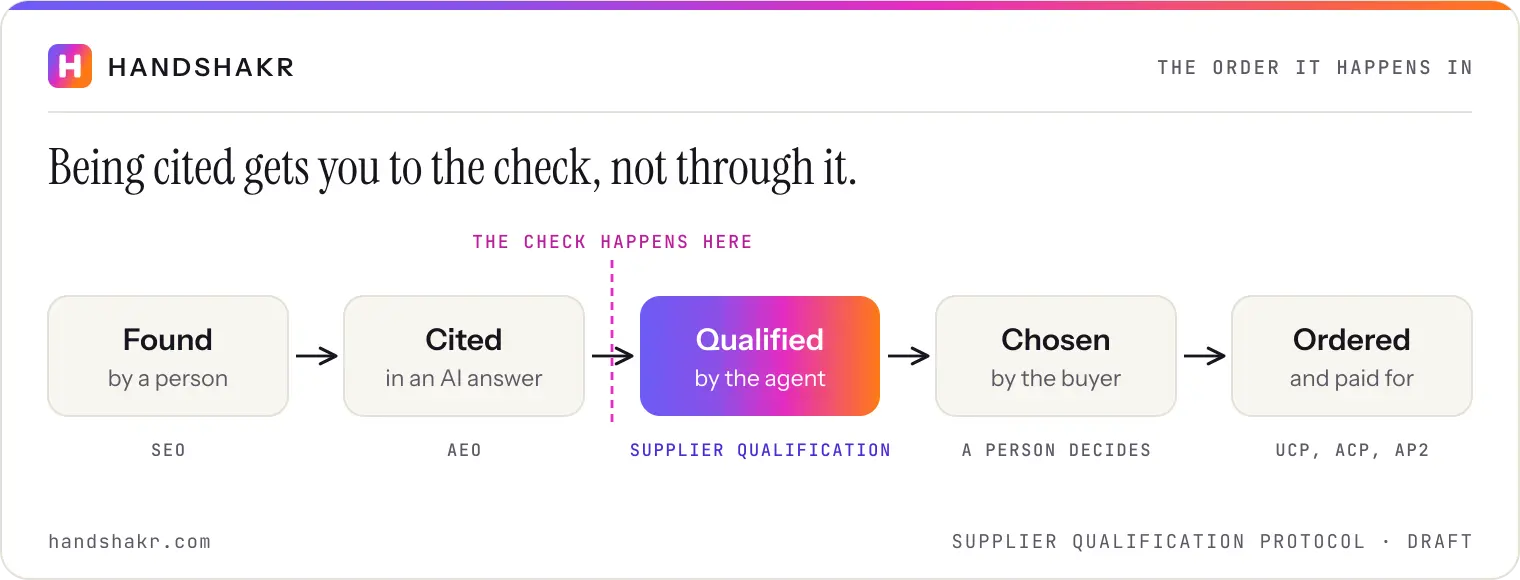
Each stage hands to the next. SEO and AEO carry a supplier as far as the check. After it, a person at the buyer decides, and the commerce and payment protocols take the order.
What the check looks like
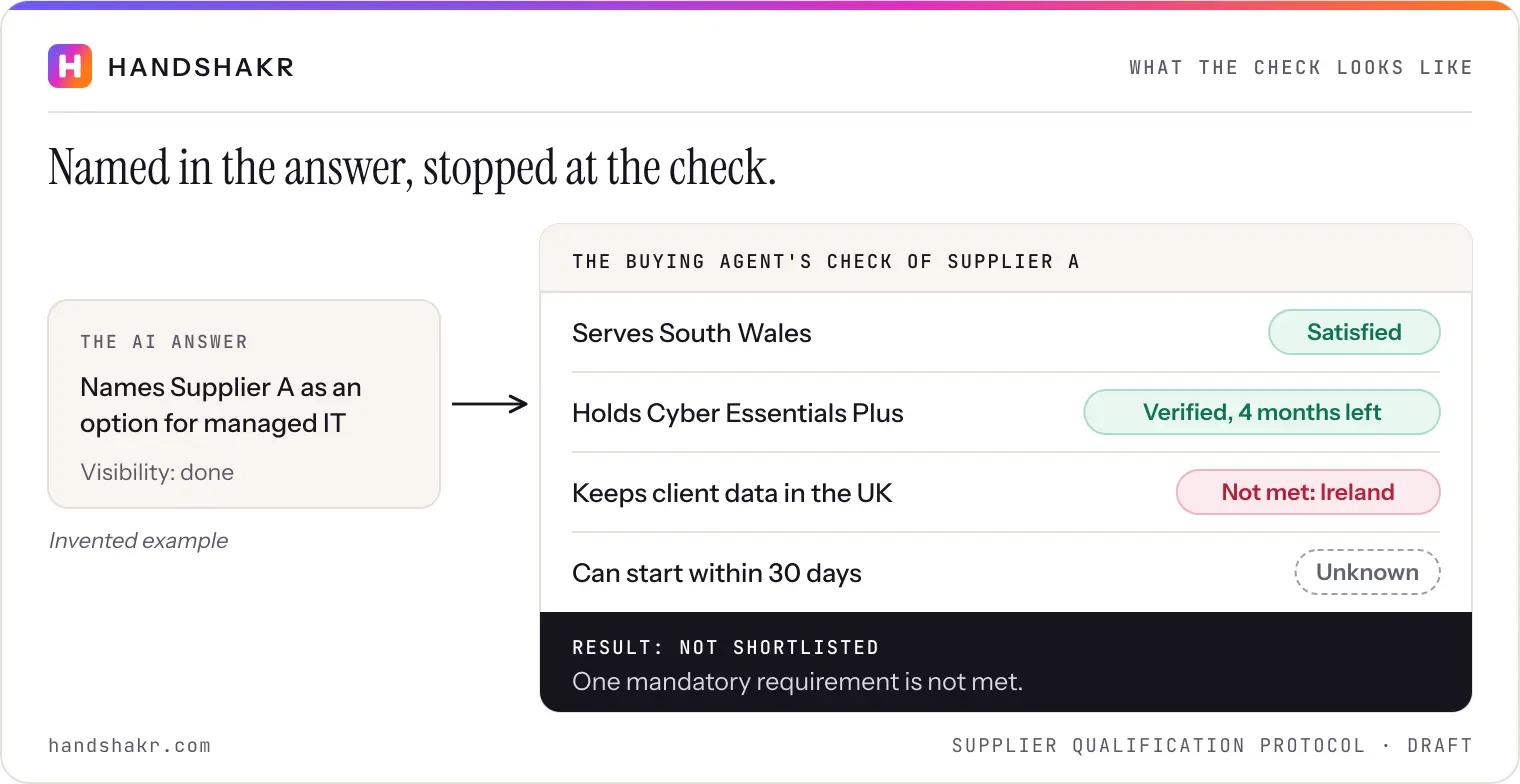
Supplier A did everything right for visibility and was named in the answer. It was stopped by its own statement about where data is held, and by one answer nobody had published.
Today the same check runs on questionnaires and PDF packs, and it is slow. In a 2021 survey of large buyers, 63% said onboarding a new supplier took 15 to 28 days, and only 5% managed it in under two weeks (HICX). An agent will not wait that long. It will move to a supplier it can check.
What a supplier can do now
Keep doing SEO and AEO. They get you found and cited, and nothing here replaces them. Then make your answers checkable:
- List the handful of facts every buyer asks for: certifications, service area, where data is held, lead time, who signs.
- State each one once, in one place, with a date. Include the ones where the answer is no.
- Attach evidence a buyer could open, or say who holds it.
- Publish it where software can read it, on your own domain.
- Keep it current. A lapsed certificate should say it has lapsed.
Handshakr is drafting an open Supplier Qualification Protocol (SQP): a way to do steps 4 and 5 so that any buying agent can check the result. It is a draft from one company, and it says plainly what is built and what is not.
Sources
- Gartner strategic predictions, October 2025, as reported by SiliconANGLE
- HICX Supplier Experience Survey, 2021: HICX